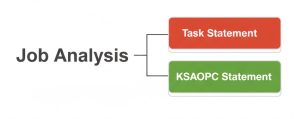
Task Statement Components are Five Elements
➥1.Action verb
➥2.Object of the verb
➥3.Rationale or observable work product
➥4.Materials, tools, procedures, or equipment used
➥5.Under what direction or guidelines
Example I:
1. Action Verb: File
2. Object: Employee documents
3. Purpose: To maintain organised personnel records
4. Tools/Methods: Using a digital HR management system
5. Conditions: Under the supervision of the HR Manager
Examples of Task Statements
I.
Transcribe (1) minutes of board meetings (2) to maintain Record of Minutes (3)
using transcription equipment (4) at the request of the Manager. (5)
II.
Direct (1) staff in emergency evacuation drills (2) to clear premises quickly (3)
using departmental disaster procedures (4) while meeting Homeland (5)
Security requirements.
III.
Interview (1) subject matter experts (2) to compile a list o job tasks parformed (5)
by incumbents using pre-selected interview questions (4) in compliance with (5)
legal and professional job analysis standards.
Exercise
1. File employee documents to maintain organized records using a digital filing system under the supervision of the HR Manager.
2. Answer customer inquiries to provide accurate information using the company knowledge base during scheduled shifts.
3. Clean office desks to ensure a hygienic work environment using disinfectant wipes every morning before staff arrival.
KSAOPC component
KSAOPC Statement are comprised of three elements:
1. What is it? Knowledge of, Skill to, or Ability to?
2. Within what context or what effect is expected?
3. To what degree of proficiency or accuracy is the KSAPC required?
The three elements of KSAOPC Statement:
I. Knowledge of advanced (3) multivariate statistics (1) to identify population characteristics and make relevant predictions. (2)
II. Ability to independently (3) develop an original structured interview for various job positions, harnessing the expertise of job incumbents and supervisors (1) to capture candidate qualifications during formal testing procedures (2)
III. Skill to finely (3) mince various food products, such as garlic, onion and ginger (1) to assist in food preparation. (2)
Note on the numbering in the image:
-
(1) refers to the main Subject/Action/Content (e.g., multivariate statistics, develop an interview, mince food).
-
(2) refers to the Purpose or Result (e.g., to identify characteristics, to capture qualifications, to assist in preparation).
-
(3) refers to the Modifier or Standard (e.g., advanced, independently, finely).
Example KSAPC Statements:
1.Knowledge of generally accepted accounting principles to conduct
complex auditing procedures.
2.Ability to work outdoors in temperatures that may exceed 100 degrees.
3.Skill to type a minimum of 45 words per minute, making fewer than two typographical errors to transcribe diction or information from various other sources.
The Context of Performance Management KSAPC Statements:
Knowledge of Basic spreadsheet software functions to generate monthly expense reports.
Ability to access information on the Internet to advance technical research projects.
Ability to work outdoors in temperatures that may exceed 100 degrees.
Ability to organise work assignments to ensure timely completion of projects
Skill to accurately cut small incisions on patients to perform basic surgeries.
Skill to type a minimum of 45 words per minute, making fewer than two typographical errors to transcribe diction or information from various other sources.
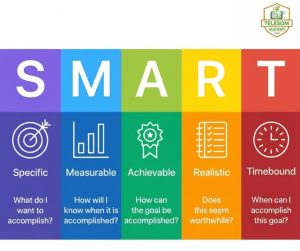
SMART GOALS
Case Study: Enhancing Field Technician Performance through Job
Redesign at Telesom Company
Background:
Telesom faced increasing customer complaints about delayed service restoration and inconsistent field technician performance. Technicians were unclear about role expectations, lacked autonomy, and had overlapping responsibilities.
• Intervention – Job Redesign:
The HR department initiated a job analysis and redesigned the Field Technician role by:
• Clarifying tasks through updated job descriptions
• Establishing clear KPIs (e.g., service restoration within 2 hours)
• Enhancing autonomy by allowing technicians to make certain on-site decisions
• Providing job-specific tools and digital troubleshooting guides
• Rotating duties to balance workload and prevent burnout
Results after 3 Months:
• 30% improvement in service restoration time
• 40% reduction in customer complaints
• Higher job satisfaction reported in staff surveys
• Improved accountability and morale
Conclusion:
Well-structured job design aligned technicians’ tasks with performance expectations and empowered them to deliver better service.